Concrete driveways
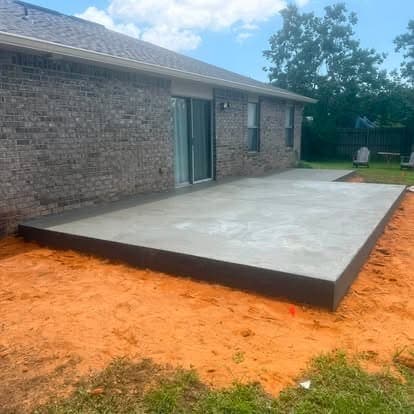
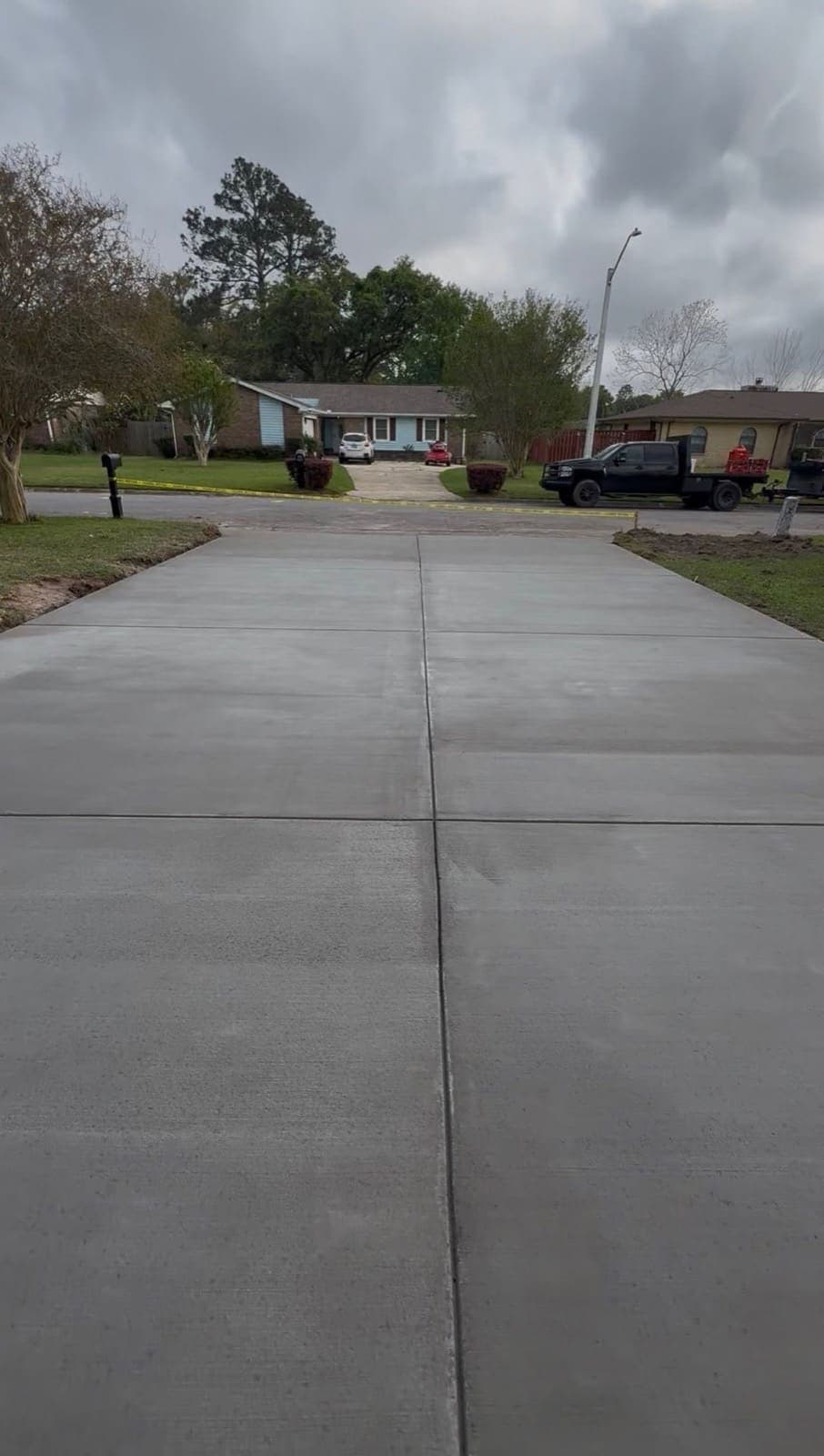
New pours and full tear-out-and-replace, from the street to the house, with control joints cut on a grid and fall built in so water leaves rather than pools.
Driveways, patios, walkways, slabs
Tear-out and replacement or fresh pours — driveways, patios, walkways, and equipment pads, formed and finished to drain properly.
The short version
We excavate to solid ground, compact the base, form for the right slope, and finish so water runs off instead of pooling against your house.
Local conditions
Up north, concrete cracks because water gets into it and freezes. That is not our problem here. On the Gulf Coast the enemy is the water itself — the Pensacola area takes roughly five feet of rain a year, and a lot of it arrives in short, violent bursts that move more soil in an afternoon than a normal month does.
Our soil makes that worse. Sandy topsoil drains beautifully until it is asked to hold something up. Water running along the edge of a slab, or off a roof with no gutter, pulls that sand out from underneath a little at a time. Eventually the slab is bridging a void it was never designed to span, and it cracks — usually in a long diagonal from a corner. People blame the concrete. The concrete was fine. The ground under it left.
The second common failure is a slab poured on soft fill that was never compacted, which settles unevenly over a few seasons. The third is a driveway with no fall away from the house, so every storm pushes water toward the foundation instead of the street. All three are base and grade problems, which is why we spend more time on what goes under a pour than on the pour itself.
Recognise any of these? Send a photo — we can usually tell you from the picture whether it needs looking at soon.
Scope
Flatwork is the bulk of what a residential concrete contractor actually does. If what you need is not on this list, ask — and if it is not something we should be doing, we will tell you that instead of quoting it.
New pours and full tear-out-and-replace, from the street to the house, with control joints cut on a grid and fall built in so water leaves rather than pools.
Where a driveway has cracked apart or settled we tear out the old slab, fix the base that caused it, and repour. Where a repair genuinely is enough, we say so.
New patios and extensions off an existing slab, formed to drain away from the house rather than trap water against it.
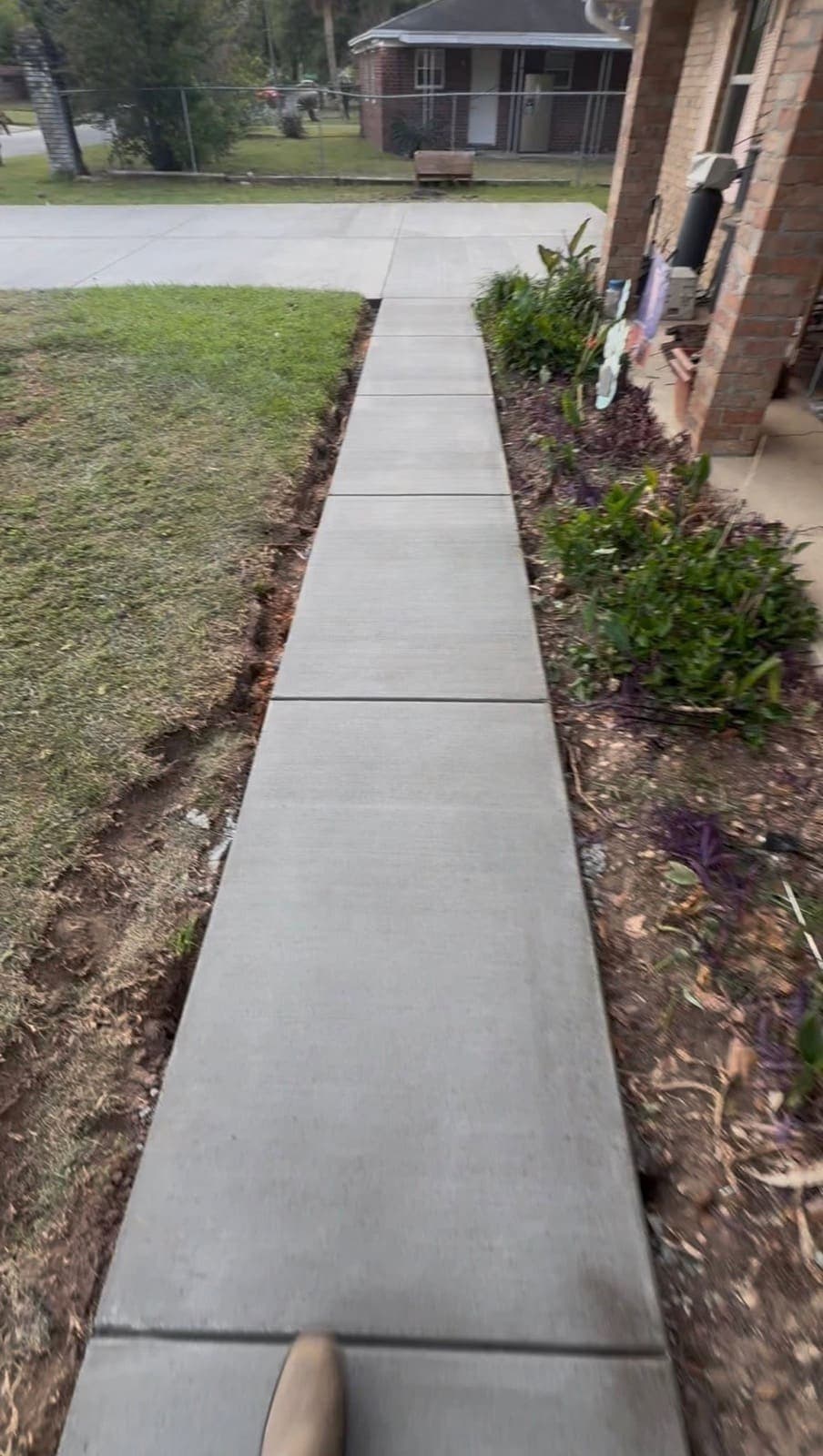
Concrete walkways and sidewalks connecting drives, entries and outbuildings, broom-finished for grip because a smooth trowel finish is slick when it is wet.
Slabs and pads for sheds, shops, RVs, boats, generators and equipment. Thickness and reinforcement — rebar or mesh — are sized to what will actually sit on it.
Formed concrete steps and ramped approaches where an entry needs to be reachable without a step up.
The transition between a drive and a garage, shop or street, which is where a lot of driveways fail first.
From the air
Drone pass over a completed residential driveway and walkway in Milton — the full run from the street to the house, joints cut straight and the surface falling away from the slab.
How we work
No mystery, no surprises. This is the order it happens in and what each stage is actually for.
We measure the area, check where water currently goes, look at how you actually use the space, and check equipment access. If the real problem turns out to be drainage rather than the concrete, we would rather tell you that at this stage than pour a slab that fails the same way the last one did.
Existing concrete, rotted decking, or old pavers come out and leave the property. Breaking out an old surface almost always reveals why it failed — washed-out base, no reinforcement, or a slab poured directly on topsoil. What we find changes the base prep, not the price we already quoted you.
We dig to firm ground, then build a compacted base back up to the right elevation. This is the step that gets skipped on cheap jobs because nobody can see it afterward. It is also the single biggest factor in whether the slab is still flat in fifteen years.
Forms are set to hold the finished elevation and, critically, the fall — the surface has to shed water away from your house and toward somewhere it can go. Reinforcement is sized to the use: a walkway and a driveway that will hold a loaded truck are not the same slab.
Concrete goes down, gets screeded and floated, and is finished to the texture you chose — usually a broom finish outdoors, since a smooth trowel finish is slick when wet and we get a lot of wet. Control joints are cut on a grid so the slab cracks where we decided it should, in a straight line, instead of wherever it wants.
Fresh concrete needs time before it takes load. We backfill the edges, clean the site, haul off the debris, and tell you plainly when you can walk on it and when you can drive on it.
Pricing
We are not going to print a price per square foot on a website, because the number would be wrong for half the people reading it and we would rather not start a relationship with a figure we have to walk back. Here is what actually drives the cost, so you can judge any quote you get — including ours.
Bigger costs more, but not proportionally — mobilization is a fixed cost, so small jobs carry a higher per-foot rate. Thickness is driven by load: a patio and a driveway that carries a work truck are specified differently.
Removing and disposing of an existing driveway, deck, or slab is real labor and real disposal fees. A fresh pour on open ground is cheaper than a replacement of the same size.
This is the variable that surprises people. A flat, firm, well-drained site needs very little. A site with soft fill, a slope, or a washout problem needs material and machine time before a form ever gets set.
If a truck can reach the pour, it is straightforward. If the concrete has to be moved by buggy or pump because of a fence, a slope, or a narrow side yard, that adds time and equipment.
If the reason the old slab failed was water, fixing the water is part of the job. That costs more up front and less over the life of the property than pouring the same mistake again.
A standard broom finish is the baseline. Exposed edges, thickened footings, steps, or a decorative finish all add labor.
Most residential driveways, patios, and walkways are a two-to-four day job on site: demolition and haul-off, then excavation and base, then forming, then the pour. Weather moves this more than anything else — we do not pour into a forecast that is going to rain on green concrete.
After the pour, concrete needs time. As a general rule you can walk on it after a day or two, and it is ready for vehicle traffic in about a week, though it keeps gaining strength for roughly a month. We will give you the specific numbers for your pour before we leave, because they shift with mix, weather, and thickness.
Free estimate, no obligation, and an honest answer about whether it is worth doing.
What to watch for
Worth knowing before you hire anyone — including us. If a quote you are looking at skips these, ask why.
The fastest way to make a driveway look new for two years. If the original base washed out or was never compacted, laying new concrete on top of it just buys a delay — the new slab settles into the same voids and cracks in the same places.
All concrete cracks. Control joints decide whether that crack is a clean line on a grid you barely notice, or a jagged split across the middle of your patio. Joints that are too shallow or too far apart do not control anything.
A surface with no fall holds water, and standing water finds the joints. A surface that falls toward the structure delivers every storm straight to your foundation. Both are avoidable with ten minutes of thought at the forming stage.
If a downspout dumps onto the corner of a new slab, or the yard grades into it, the new pour is on the same clock as the old one. The concrete and the water have to be solved together.
Proof
Questions
Something not covered here? Ask us directly — we would rather answer it than have you guess.
Ask about your projectWe do not quote per square foot, and you should be a little wary of anyone who does over the phone. The same size driveway varies a lot depending on whether an old slab has to come out, how far a truck can get to the pour, how much base has to be built up, and whether the reason the last one failed is still there. A per-foot number quoted before anyone has seen the property is a number that has to move later. We give a written figure after a free site visit.
Most of the year is workable here — we do not have a freeze window to plan around. What actually governs the schedule is rain and heat. We will not pour into a forecast that is going to rain on green concrete, and in peak summer heat the mix and the finishing window both need managing. Practically, that means we watch the forecast rather than the calendar.
We do light commercial and agricultural flatwork — shop and outbuilding slabs, equipment pads, walkways and ramped entries around small commercial buildings. Large-scale commercial paving and parking lots are not what we do, and we will say so rather than take the job.
Yes, and the important question is what will actually sit on it. A pad that holds an RV or a loaded trailer is specified differently from one holding a shed — thickness and reinforcement get set from that load, not from a default.
It depends on what is going to drive on it. Residential driveways carrying normal passenger vehicles are specified differently from a pad that will hold an RV, a boat trailer, or a loaded work truck. Thickness and reinforcement get decided together based on that load — tell us what will actually park on it and we will spec it accordingly.
Sometimes, but be careful. Resurfacing is a cosmetic fix over a structural problem. If the cracking is from base washout or settlement, an overlay will telegraph the same cracks through within a season or two. We will tell you honestly which situation you are in after looking at it.
Typically around a week for normal vehicles, though it varies with mix, thickness, and weather. You can usually walk on it much sooner. Concrete keeps gaining strength for about a month after the pour, so heavy loads should wait longer. We will give you the exact numbers for your pour.
Almost certainly, somewhere — that is normal and not a defect. The job of good work is to control where. Proper base, correct reinforcement, and control joints cut on a sensible grid mean the cracking happens in straight lines at the joints instead of randomly across the surface.
It depends on the scope, the location, and whether you are altering drainage or working in a right-of-way. Requirements change, so we check the current rules for your specific address rather than guessing. We will tell you what is needed before work starts.
Yes, and it is one of the more common jobs we do. Wood decks in this climate have a hard life — moisture, humidity, and subterranean termites all work against them. A properly based slab in the same footprint is a permanent answer to a structure you would otherwise be replacing again.
Often paired with
These jobs disturb the same ground. Doing them together usually costs less than doing them one at a time.
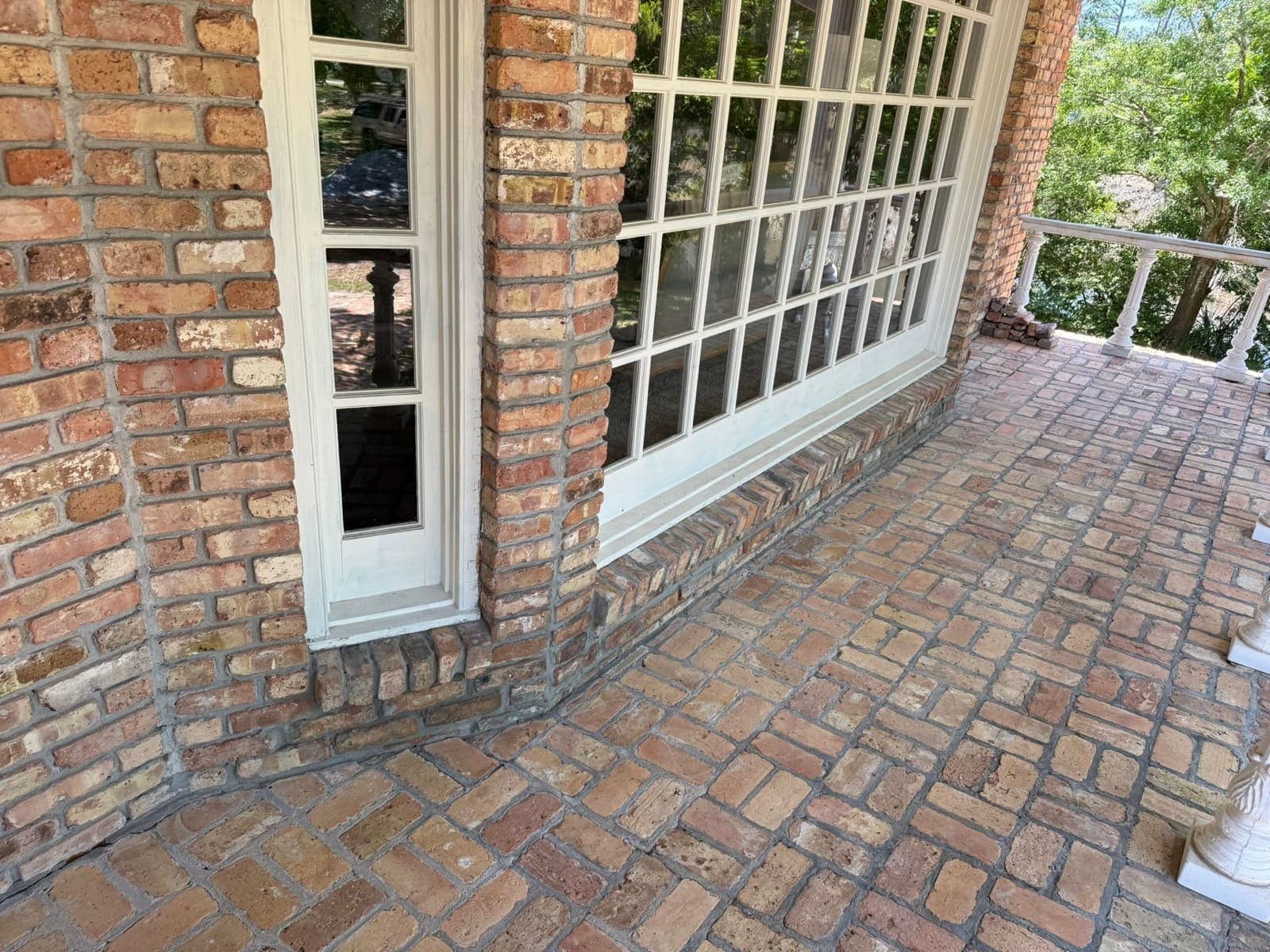
Settled brick, cracked mortar joints, and failing window sills rebuilt to match the existing masonry.
Learn more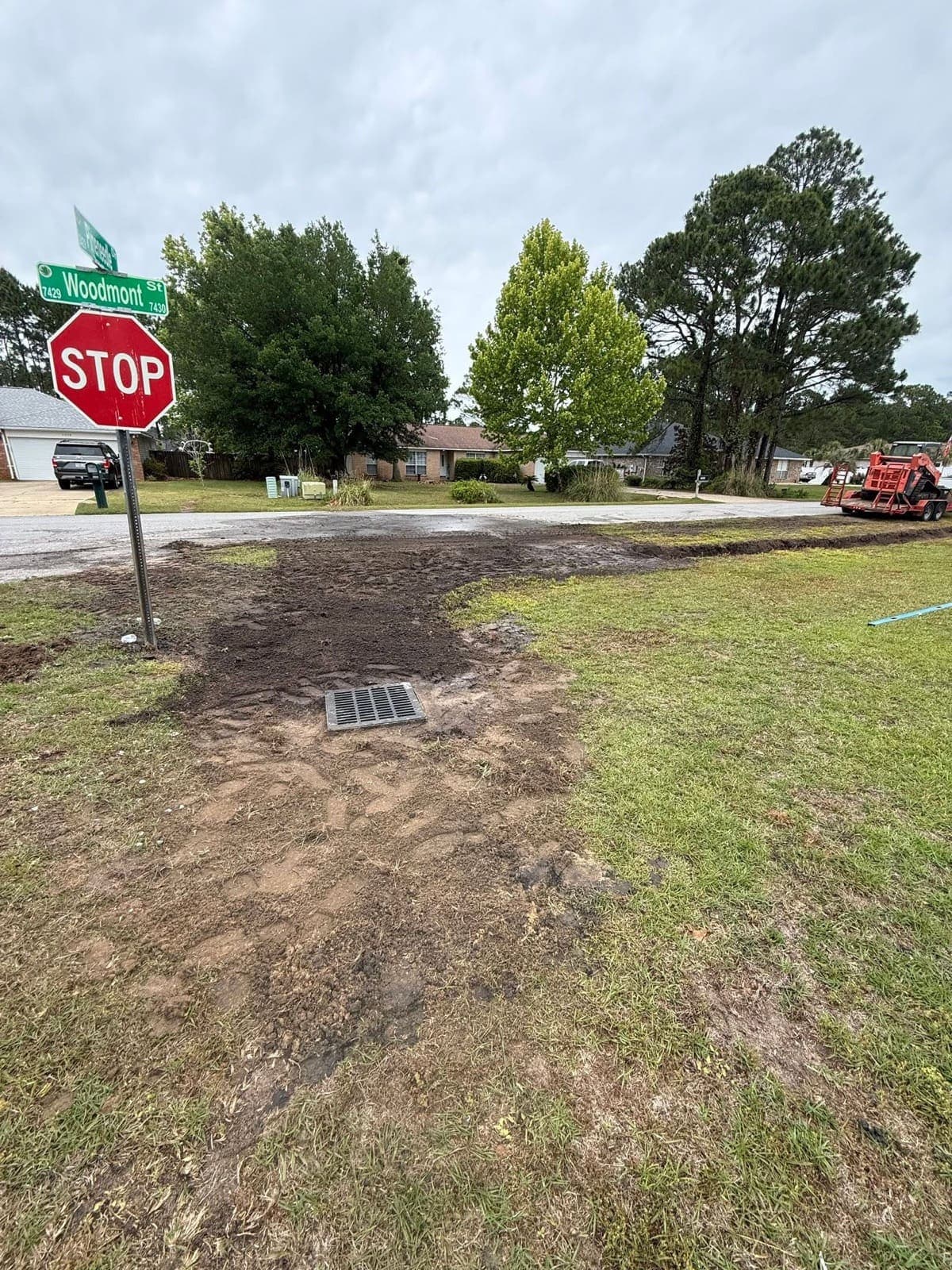
Catch basins, buried drain lines, and regrading that move water away from your foundation instead of into it.
Learn more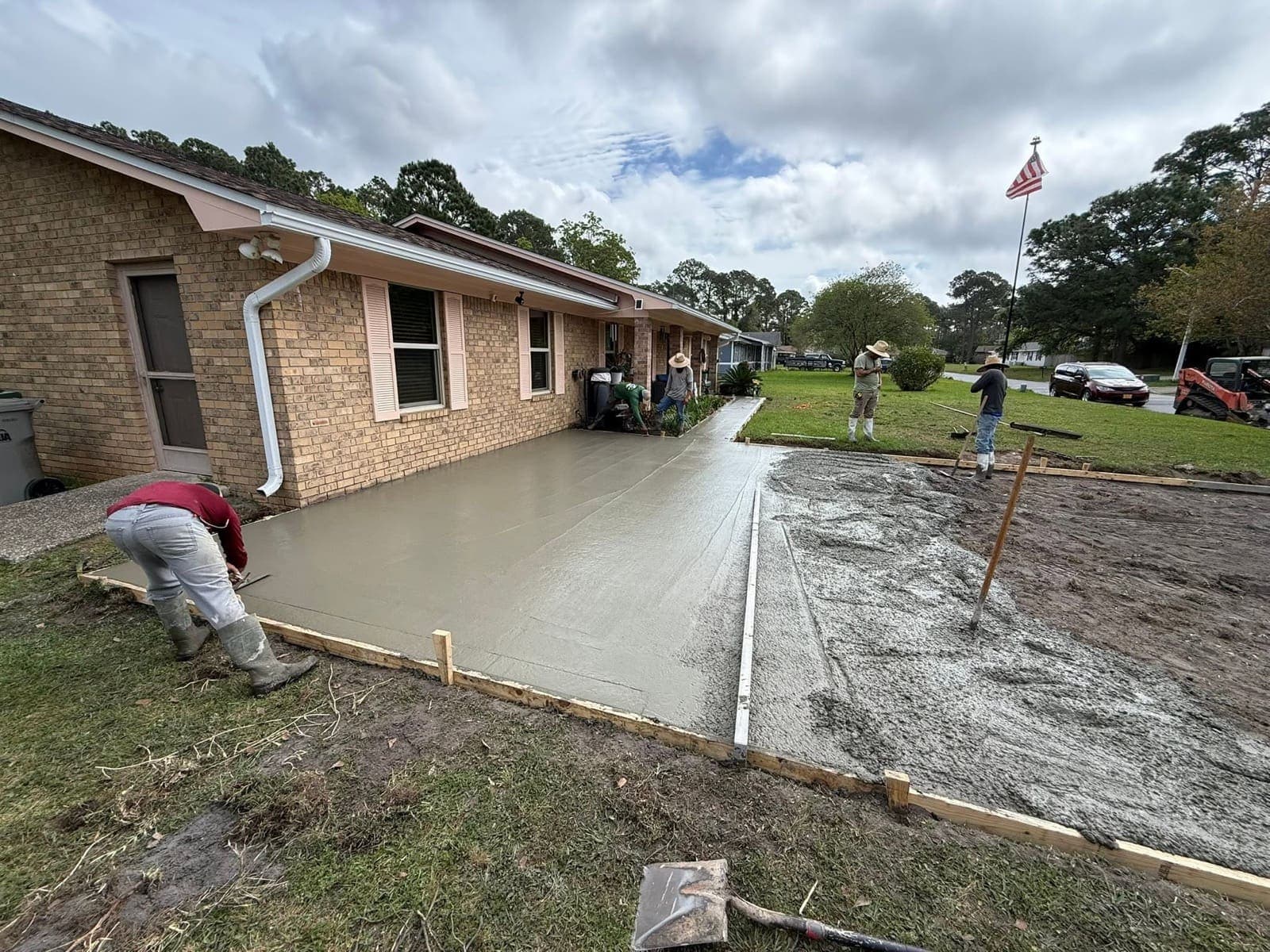
Skid-steer clearing, grading, and site preparation that gives whatever comes next a level, stable base.
Learn moreFree estimate
Send a couple of photos and a sentence. We will tell you honestly whether it is something we should come look at — and what it is likely to take.