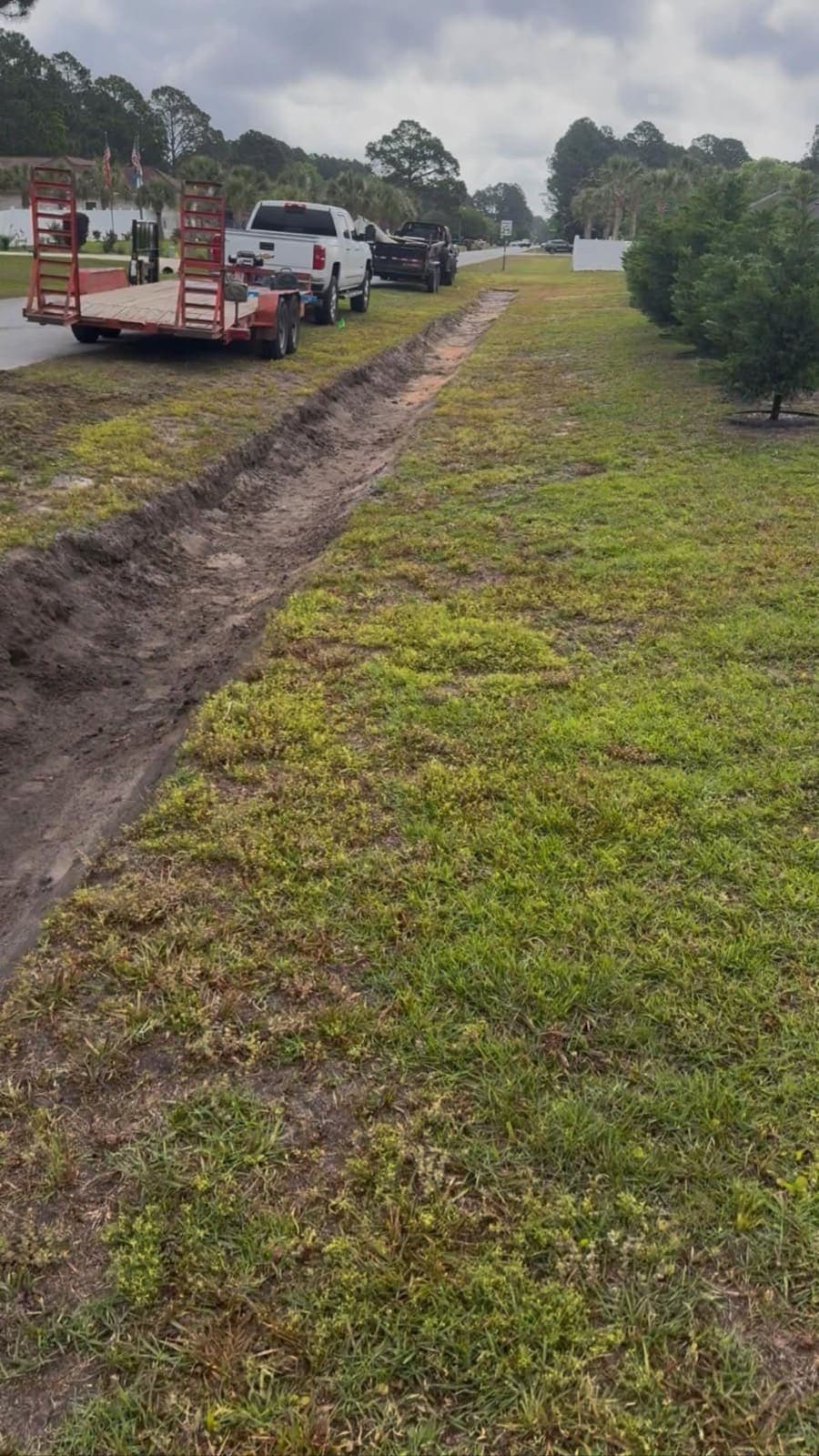
Catch basins
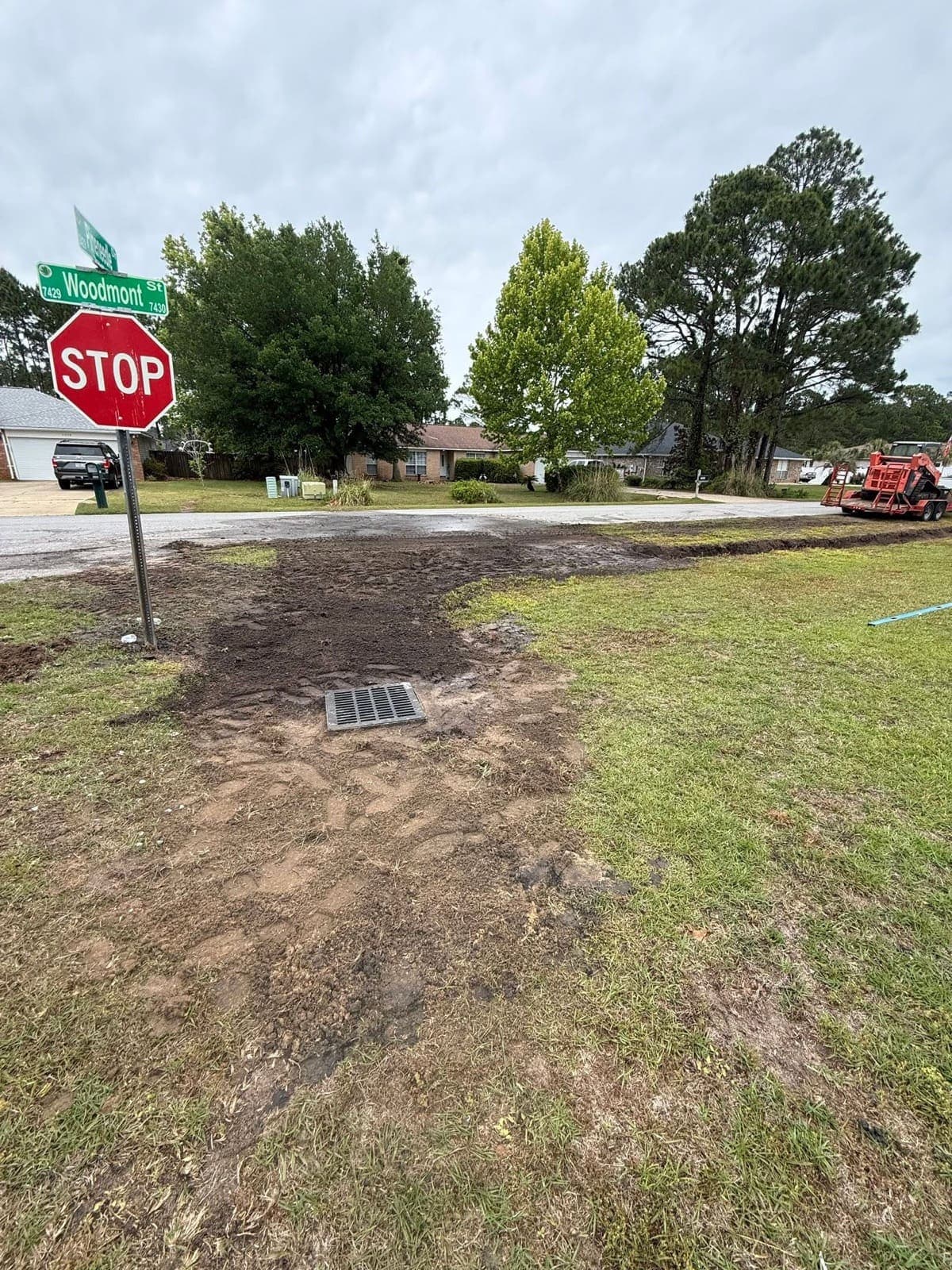
Formed and set at the low points where water actually collects, with the grate flush to finished grade so it takes water and does not catch a mower.
Catch basins, drain lines, regrading
Catch basins, buried drain lines, and regrading that move water away from your foundation instead of into it.
The short version
We walk the property, find where water enters and where it has nowhere to go, then combine regrading with catch basins and buried line to give it a route off the lot.
Local conditions
Northwest Florida gets an enormous amount of rain — well over four feet in an average year around Pensacola and Milton, and much of it in intense summer storms and tropical systems that drop several inches in a matter of hours. Very few residential lots were graded with that kind of event in mind.
The soil profile does not help. Sandy topsoil takes water quickly, which is why a yard can look fine after a light shower. Underneath it there is often a denser layer that water moves through far more slowly. In a heavy storm the sand saturates, the layer below refuses to take any more, and the water has nowhere left to go but sideways and up. That is the yard that is fine all spring and a swamp for three days after a real storm.
Then there is the fact that most lots around here are flat. Water needs somewhere to go and a slope to get there. On a flat lot with a neighbour's runoff arriving from one side, no defined low point, and a house sitting in the middle, standing water is not a mystery — it is the predictable result. Fixing it means giving the water both a destination and a fall to reach it.
Recognise any of these? Send a photo — we can usually tell you from the picture whether it needs looking at soon.
Scope
A drainage contractor is rarely installing one product. Almost every job here is a combination. A drain with nowhere to go is just a buried bucket, so the destination gets settled before anything is installed.
Formed and set at the low points where water actually collects, with the grate flush to finished grade so it takes water and does not catch a mower.
Line bedded and run to consistent fall toward a legitimate outfall. Flat line silts up and stops working within a couple of seasons.
Where a perforated, gravel-wrapped run is genuinely the right answer — which is less often than people expect, because most standing water is a grade problem first.
Reshaping the surface so water leaves the property instead of collecting. On a flat lot this does most of the work.
Foundation drainage — moving runoff away from footings and slab edges — which is what stops the base washout that cracks concrete and settles brick.
On acreage and rural drives, getting water under an access route instead of across it.
Trenches backfilled and compacted, and the disturbed ground put back with sod or seed.
How we work
No mystery, no surprises. This is the order it happens in and what each stage is actually for.
The most useful time to look at a drainage problem is during or just after a real rain, when you can see where water enters the property, where it collects, and where it is already trying to go. If you can take photos or a short video next time it floods, that is genuinely valuable to us.
This is the part that decides whether the job is simple or complicated. Water has to end up somewhere legitimate — a street, a ditch, a swale, or a properly sized dry well. A drain that collects water and delivers it nowhere is just a buried bucket.
Buried drain line only works if it runs consistently downhill. That constraint, more than anything else, dictates the route and the depth of the trench. Getting it wrong produces a line that holds standing water, silts up, and stops working within a couple of seasons.
Basins go at the collection points — the low spots where water actually sits, which is not always where people expect. Line is bedded and backfilled, and grates are set flush to finished grade so they take water and do not catch a mower.
Buried drainage handles volume. Surface grading decides where the water goes in the first place. Most jobs need both: a graded fall away from the structure toward the collection points, plus swale work where runoff arrives from off the property.
Drainage work tears up a yard. Trenches get backfilled and compacted, and the disturbed ground is put back with sod or seed so the property does not look like a construction site once the water problem is solved.
Pricing
Drainage pricing has less to do with the size of the yard than with how far the water has to travel and what is in the way. Two houses on the same street can be very different jobs.
If the property has a street, ditch, or swale within reach and there is fall to get there, the run is short. If the only viable discharge point is at the far corner of the lot, that is significantly more trench.
A lot with natural slope is straightforward. A dead-flat lot requires the trench to get progressively deeper along the run to maintain fall, which means more excavation and more spoil to deal with.
One low spot needs one basin. A property with several distinct problem areas needs several, plus the line to tie them together.
Driveways, walkways, mature tree roots, irrigation, and utilities all complicate a run. Crossing a driveway is a very different proposition from crossing open lawn.
How much surface regrading the fix needs, and how much sod goes back down afterward, both move the number.
A typical residential drainage job runs one to three days on site depending on the length of the run and how many collection points are involved. Crossing hard surfaces or working around mature roots and utilities adds time.
You will see the result the next time it rains properly. Restored sod needs a few weeks and consistent watering to knit in — expect the yard to look disturbed for a while after the water problem itself is solved.
Free estimate, no obligation, and an honest answer about whether it is worth doing.
What to watch for
Worth knowing before you hire anyone — including us. If a quote you are looking at skips these, ask why.
The single most common failure. A pipe that is flat, or worse, runs uphill somewhere in the middle, holds water permanently, silts up, and stops draining. It looks like a drainage system and functions as a buried trough.
Basins and pipe that terminate in the middle of the yard, or into ground that is already saturated, do not solve anything. The discharge point has to be settled before the first shovel goes in.
Solving your standing water by routing it onto the property next door is not a solution, it is a dispute. Water needs a legitimate destination.
If the surface still falls toward the house, a buried line will not save you. Grade decides where water goes; pipe only carries what reaches it.
A basin sitting above finished grade will not take the water pooling around it, and it will meet a mower blade eventually. Grates go flush.
Questions
Something not covered here? Ask us directly — we would rather answer it than have you guess.
Ask about your projectLess than people expect in some yards and more in others, because the cost is driven by how far the water has to travel and what is in the way rather than by the size of the yard. Distance to a legitimate outfall, how much fall is available, how many collection points there are, and whether the run has to cross a driveway all move the number more than the length alone.
Sometimes, but it is not a universal answer and it is often the wrong first move. A buried drain only works if there is somewhere for the water to go and enough fall to get it there. On a lot of properties around here, regrading the surface does more than any pipe would.
Get the grade falling away from the slab first, then give the water a route off the lot. Water standing against a footing washes out the soil supporting it, and that is a common cause of both cracked concrete and settled brick — so it is considerably cheaper to redirect than to repair what it undermines.
Usually one to three days on site depending on the length of the run and how many collection points are involved. Crossing driveways, mature roots or utilities adds time. You will see the result the next time it rains properly; restored sod takes a few weeks to knit in.
A puddle that clears within a few hours of the rain stopping is normal. Water that is still sitting a day or two later means it has nowhere to go, and that is worth fixing — persistently saturated ground kills grass, undermines slabs and footings, and breeds mosquitoes.
Sometimes, but it is not a universal answer and it is frequently the wrong first move. A buried drain only works if there is somewhere for the water to go and enough fall to get it there. On a lot of properties, regrading the surface does more than any pipe would.
It can be. Persistent water against a slab or footing washes out the supporting soil over time, which is one of the most common causes of both cracked concrete and settled brick. It is a lot cheaper to redirect the water than to repair what it undermines.
That is generally the right way to do it. Drainage, grading, concrete, and sod all disturb the same ground. Doing them as one project means the yard is torn up once, and it usually costs less than sequencing them as separate visits.
Somewhere legitimate — typically a street, ditch, swale, or a properly sized dry well, depending on what your property has available. Establishing that destination is the first thing we work out, because everything else in the design follows from it.
Yes. We backfill and compact the trenches and restore the disturbed ground with sod or seed. Expect a few weeks of it looking patched while the new grass roots in.
Often paired with
These jobs disturb the same ground. Doing them together usually costs less than doing them one at a time.
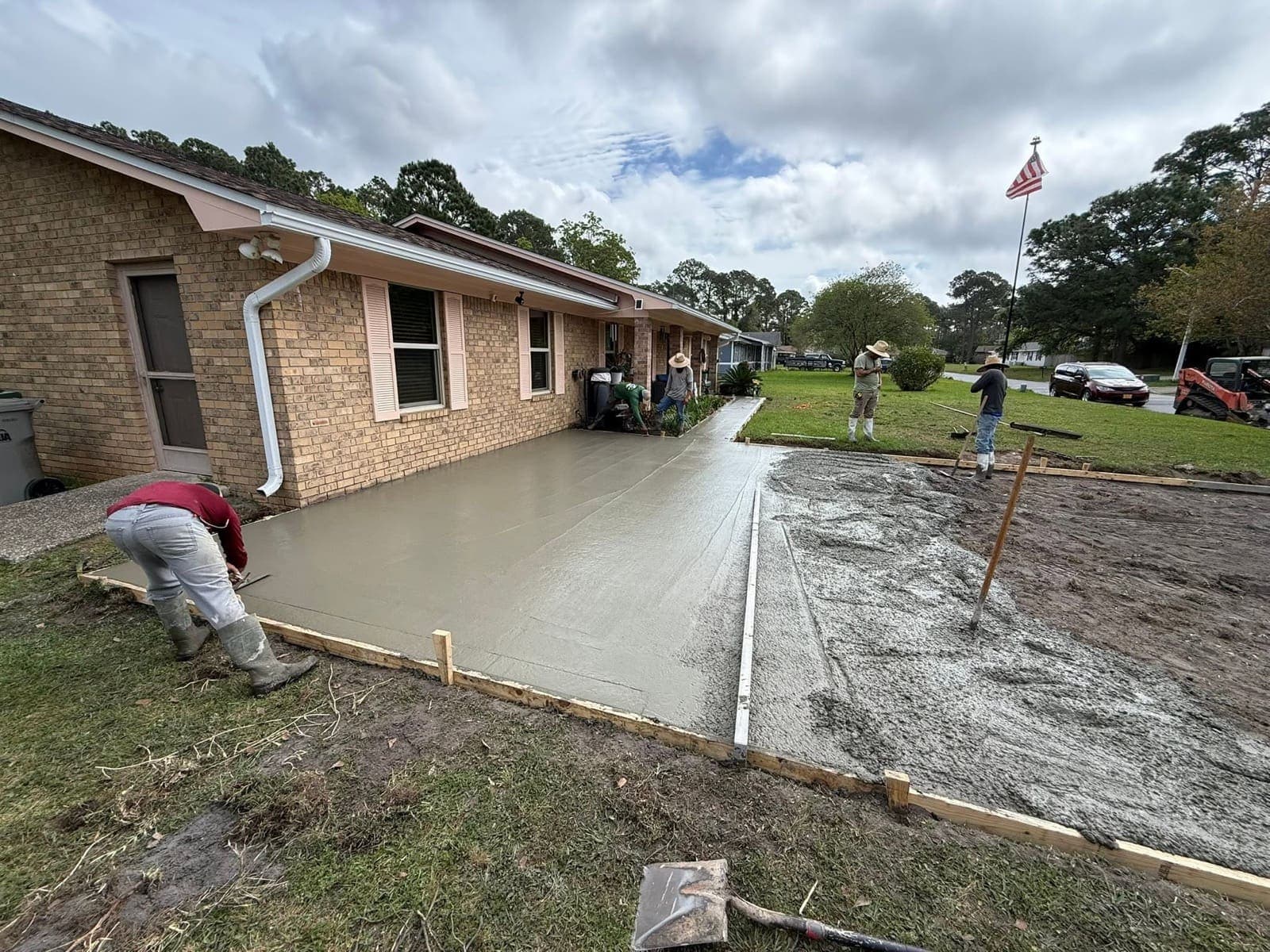
Skid-steer clearing, grading, and site preparation that gives whatever comes next a level, stable base.
Learn more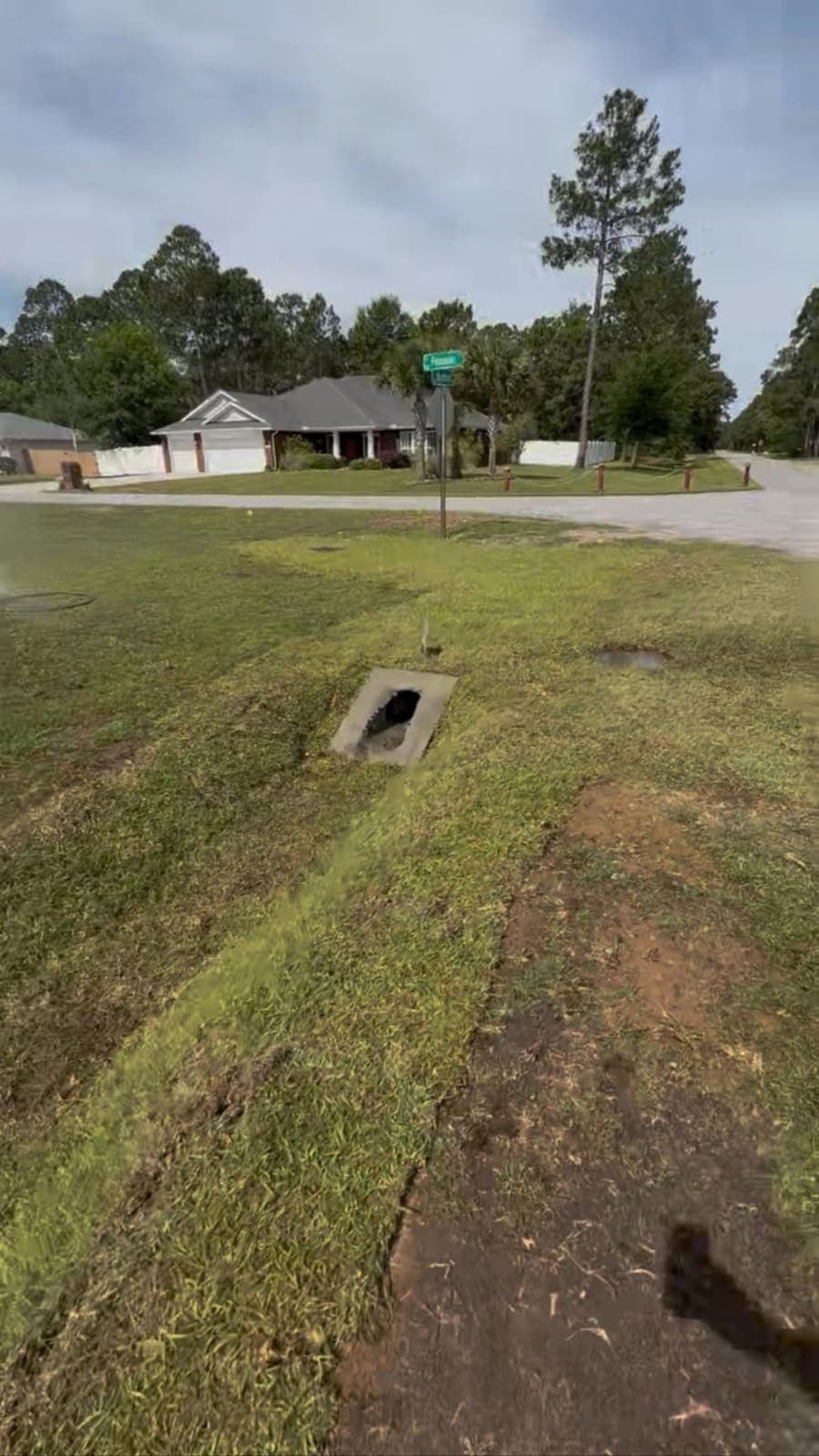
Graded, prepped, and laid sod that takes root — including restoring the ground after drainage or concrete work.
Learn more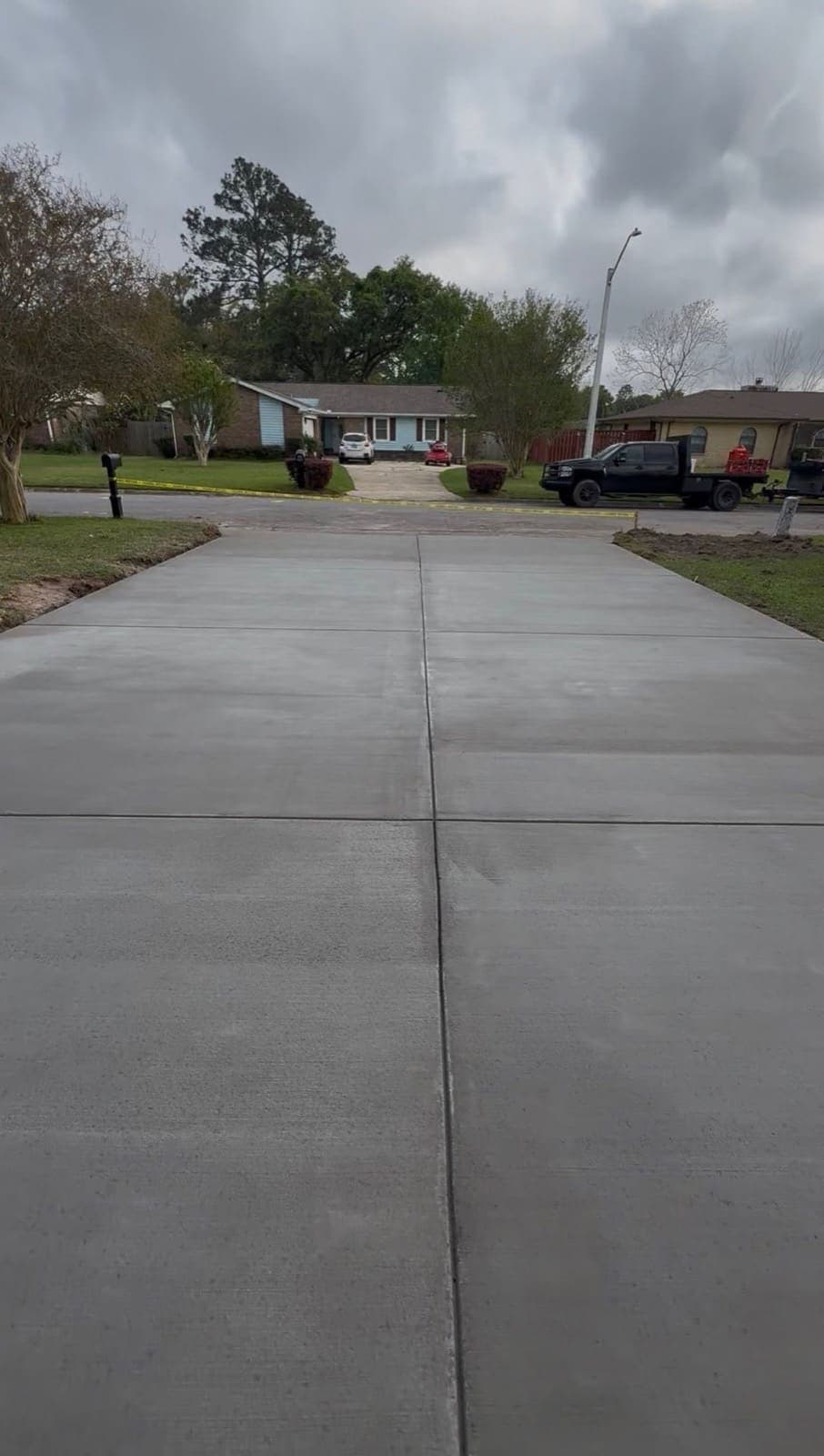
Tear-out and replacement or fresh pours — driveways, patios, walkways, and equipment pads, formed and finished to drain properly.
Learn moreFree estimate
Send a couple of photos and a sentence. We will tell you honestly whether it is something we should come look at — and what it is likely to take.